Article written by Loredana Regep - EMCC Romania member and co-lead of RESILIO Programme for EMCC Romania
The gap current healthcare systems leave
In medical school, I learned to diagnose and treat illness. Then I spent two decades in pharmaceutical and biotech companies whose medicines do exactly that. It is essential work, one that saves countless lives.
Medicine also knows that many diseases are preventable. A healthy way of living is primary prevention, keeping disease from starting, and secondary prevention, slowing or halting a condition caught early. Every doctor knows this. Few have the time to help a patient actually live it.
It also tends to arrive late. A healthy lifestyle can stop many diseases before they start (primary prevention), halt or reverse them when they are caught early (secondary), and limit their impact once they are established (tertiary). Yet knowing this rarely changes how anyone lives.
And a person who is no longer ill on paper is not automatically well. Many are tired, stressed, disconnected, and unsure how to change. Investigations may show nothing is wrong or not enough to reach a clinical threshold. That gap, between knowing and doing, is where health and wellbeing coaching works, and it is why I became a coach.
What it is, and what it is not
The National Board for Health & Wellness Coaching (NBHWC) describes coaches as partnering with clients who seek ”self-directed, lasting changes, aligned with their values”;
In my own words: I help people turn what they already know and desire about their health into what they actually do, in a way that fits their life. The client sets the direction. They are the experts in their priorities, values and what their life should be about. I am a partner who brings structure, evidence-based behaviour change methods, and trust in their capacity.
As a coach, I do not diagnose, prescribe or treat. Coaching is not therapy, nor is it medical advice, even when the coach is also a doctor. Knowing that boundary, and when to refer, is part of the competence and aligned with one’s professional integrity.
In a space where opinion and personal experience so often stand in for evidence, working from what the science supports, and being honest about its limits, is an ethical duty to the client.
EMCC colleagues will recognize the method. What differs is the territory.
The illness-wellness continuum
The clearest picture I know of that territory was drawn by a physician, John W. Travis, in 1972.
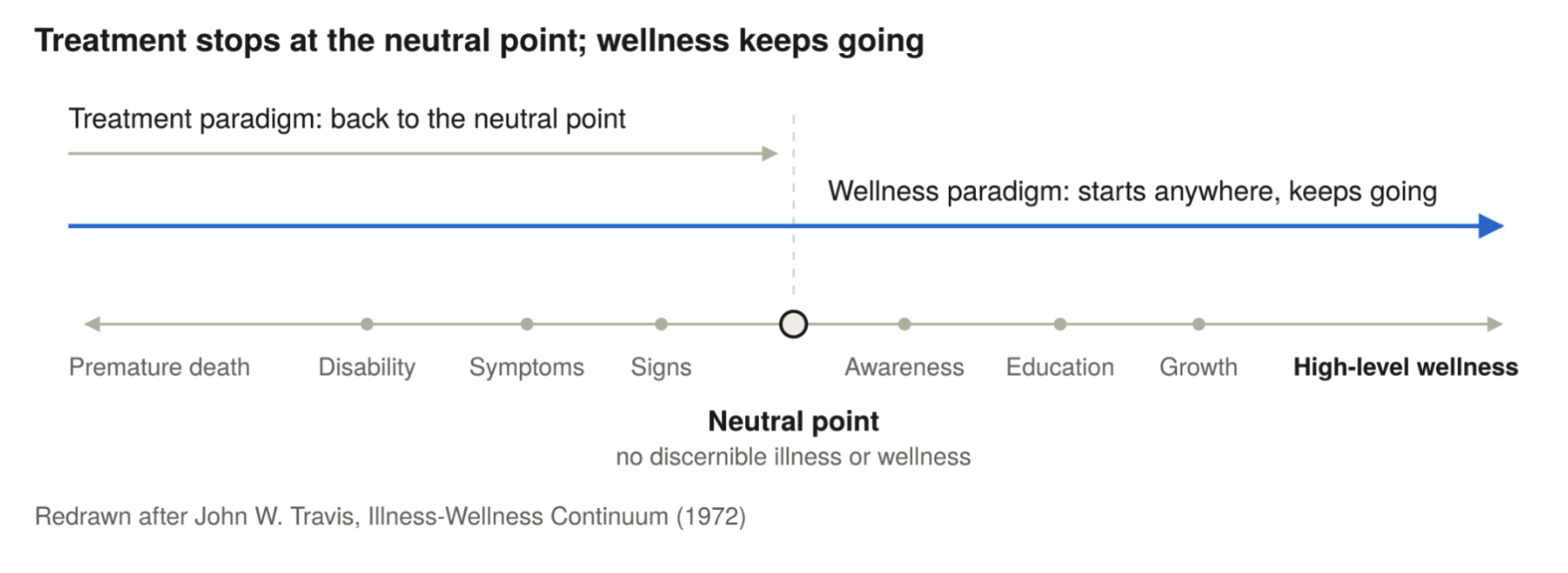
Medicine, the treatment paradigm, is designed to bring people from the left back to the neutral point. The wellness paradigm can begin anywhere on the line and keeps going to the right. The two are meant to work together.
Travis added that where a person stands matters less than which way they are facing. Health and wellbeing coaching lives in that second arrow: it helps people turn around and keep walking toward their full potential.
The whole person health approach
Moving to the right is rarely about one thing. Tools such as the Wheel of Life, or the Circle of Life from the Institute for Integrative Nutrition, map the areas that nourish a person: relationships, career, finances, physical activity, home environment, social life, spirituality, joy.
A client may arrive wanting to lose weight and discover that the real lever is sleep, a stressful job or a relationship that drains them. Health and wellbeing coaching follows the client there. It treats food and exercise as part of a life, and the life as part of the health.
What McKinsey adds
In September 2026, the McKinsey Health Institute published The future of healthy living. It is written for governments and never mentions coaching. It still reads like the economic case for the right-hand side of that line.
People spend roughly half their lives in less-than-great health.
Of 23 modifiable drivers of health, 19 sit outside the healthcare system: diet, movement, sleep, stress, social interaction, mindsets and beliefs.
In the best-case scenario, addressing modifiable risks could add up to 12 healthy years to a life.
The authors call for healthy living that is "socially supported rather than individually heroic." That is a fair description of what a coach offers, one person or organization at a time.
Payers are starting to agree. From January 2027, the US Medicare programme will pay for health and well-being coaching.
An invitation
Whatever your niche, your clients bring their energy, their sleep and their stress into the room. You do not need to become a health coach to notice which way they are facing on that line.
Next time, ask. And if what you hear is beyond your scope, know a colleague who works in this territory. I would be glad to be one of them.
Sources
McKinsey Health Institute, The future of healthy living: A $16.4 trillion opportunity, September 2026 (report PDF).
John W. Travis and Regina Sara Ryan, Key Concept #1: The Illness-Wellness Continuum, Wellness Workbook.
NBHWC, Code of Ethics (definition of health and wellness coaching).
NCHEC: national payment for health and well-being coaching, 5 November 2026.