From Solving to Sensing, and Back Again
A Five-Dimensional Map for Coaching Practice
Article written by Vlad Duțescu - EMCC România’s President, Notes from the EMCC Global Annual Conference, Zagreb, May 2026
A Framework Encountered
One session at the EMCC Global Annual Conference in Zagreb introduced a developmental framework distinguishing three modes of coaching practice, labelled 3D, 4D, and 5D. The presentation moved From Solving to Sensing: 3D coaching is goal-focused and structured, oriented toward fixing the problem and improving the system; 4D coaching becomes reflective and pattern-aware, working with what is underneath; 5D coaching is presence-led, intuitive, and field-aware, listening for what wants to emerge.
Accompanying the model was the 5D Field Inquiry, a sequence (Arrive, Open, Receive, Discern, Embody) for moving into the field-aware mode. A handout summarised the three realities as developmental positions on a continuum from surviving and solving, through awakening and integration, toward coherence and co-creation. A welcome caveat sat at the foot of the page: "This model is a developmental metaphor, not a hierarchy of human worth."
During the table group exercise, our task was to build and refine the framework, adding our own descriptors. What emerged on our paper was not so much a refinement as an extension, and one that, on reflection, has implications worth setting out. It was a excellent reflective lab session with great experiential learning and sharing facilitate gracefully by Roberto Blain, Lise Lewis and Irena Antolić.
The same day, the conference closed with a keynote by David Clutterbuck, What is the profession becoming and how are we shaping it? which articulated, in its own register, several of the distinctions our table group had been working with. Where the resonance is most direct, I draw on it below. This article is the synthesis of three things: the framework as presented in the session, the conversation our table group developed during the exercise, and Clutterbuck's closing keynote.
What the Original Model Quietly Assumes
The framework as presented begins at 3D. That choice has consequences. It bundles two quite distinct coaching moves, problem-solving and perspective-taking into a single band, and it leaves unarticulated the substrate from which "3D" itself emerges.
In our group, the conversation pulled us downward: before we could speak about consequences propagating through systems (the territory we ended up naming as 3D), we needed to name the simpler register where coaching addresses a discrete issue, and the register where two perspectives can be held side by side. Hence a five-dimensional map rather than a three-dimensional one.
1D: The Linear Register
In 1D, coaching is the conversion of an issue into a solution. The work moves in a straight line from problem statement to action plan. This is the territory mapped most explicitly by John Whitmore's GROW model (Coaching for Performance, 1992) and the wider solution-focused tradition descended from Steve de Shazer and Insoo Kim Berg.
1D is sometimes dismissed as transactional or shallow. That is a mistake from my perspective. There are moments in any coaching relationship where the appropriate move is to help the client define the issue, generate options, and commit to action. A leader with a board paper due tomorrow, a manager facing an immediate personnel decision, a professional preparing for a high-stakes conversation in three days, these clients do not need a developmental excursion. They need a competent linear partner. To push them elsewhere is to mistake one's own developmental preference for the client's actual need. Based on my own experience, this is when situational mentoring is mostly needed.
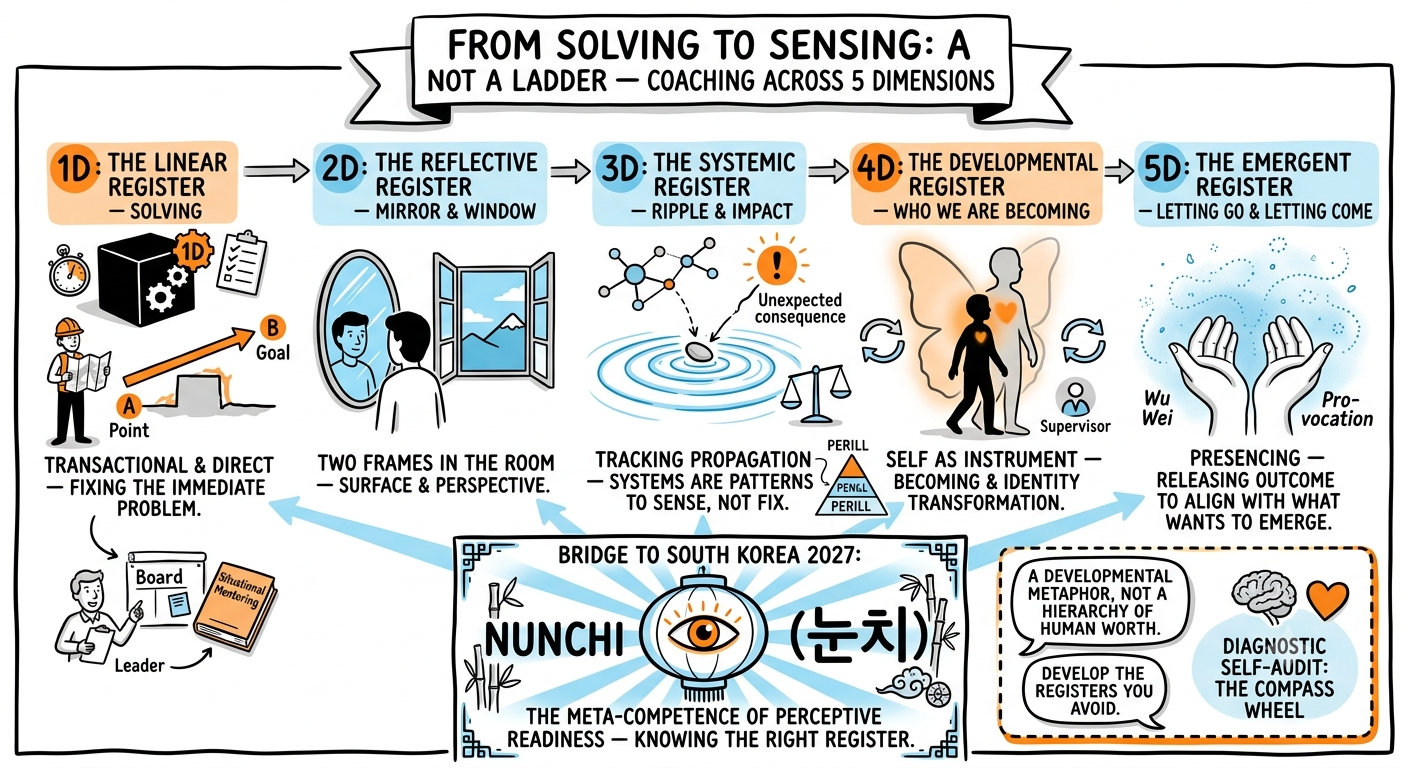
Visual Representation of the article according to Gemini AI
2D: The Reflective Register - Mirror and Window
In 2D, coaching introduces the second perspective. The client's frame is no longer the only frame in the room.
Two metaphors are useful here. The mirror turns attention back toward the client - surfacing what they have said, how they have said it, what is present in their voice and posture, what is implicit in their framing. The window offers a view from and to outside - another lens, another reading, another way the situation might look. Both moves were anticipated in Joseph Luft and Harry Ingham's Johari Window (1955) and elaborated in Donald Schön's The Reflective Practitioner (1983).
For those working in mentoring, 2D is foundational. I see the mentor providing context and challenge the mentees thinking as an window open towards horizons that otherwise the mentee is not able to comprehend alone. Without 2D, the deeper developmental registers, coaching and mentoring, have no place to land.

Photo by Izzy Gibson
3D: The Systemic Register - Ripple and Impact
It is at 3D that systems thinking properly enters the coaching conversation. The work begins to track propagation: how an action, a decision, a pattern radiates through the relational and organisational field. Consequences are no longer local. Causes are no longer linear.
This is the territory mapped by Peter Senge's The Fifth Discipline (1990), by Donella Meadows' Thinking in Systems (2008), and most directly for team coaching practice, by David Clutterbuck's PERILL model, which gives the team coach a structured way to read the interaction of Purpose, External Stakeholders, Relationships, Internal Processes, Learning, and Leadership.
This re-reading of 3D differs from the conference handout, which placed fix the problem, improve the system within the 3D band. That description, I would argue, belongs largely to 1D. What distinguishes 3D, from my perspective, is precisely the recognition that the system is not a thing to be fixed but a pattern of relationships to be sensed, and that any intervention will ripple in ways the coach and client cannot fully predict.
This unbundling was independently articulated in Clutterbuck's closing keynote, in his contrast between linear and systemic thinking. He named seven oppositions: fix the problem against understand the context; maintain control against enable and empower; discrete solutions against interconnected solutions; predicted and predictable outcomes against emergent and evolving outcomes; static processes and procedures against evolving processes; hierarchical communication against unbounded communication; seeking certainty against living with uncertainty. The first column of that contrast is precisely what I am calling 1D; the second is 3D. The fact that the conference handout placed the first-column language inside the 3D band is exactly what produced the bundling our table group thought we had to undo.
4D: The Developmental Register - Who We Are Becoming
In 4D, the work begins to remake the identity of the people doing it, including the coach.
Robert Kegan's constructive-developmental theory (In Over Our Heads, 1994) describes this as a movement from being subject to one's identity to being able to take one's identity as object. The story one has been telling about oneself becomes something one can examine, question, and revise. Jack Mezirow's transformative learning theory and Chris Argyris and Donald Schön's account of double-loop learning describe parallel movements at the level of belief and frame.
What our table group articulated, and what I want to underline here, is that 4D coaching does not only transform the client. It transforms the coach. Tatiana Bachkirova's framing of self as instrument and Peter Hawkins' developmental supervision both insist on this. The coach is not a neutral conduit through whom transformation passes; the coach is themselves remade by the work, session by session, year by year. This is one of the principal reasons supervision exists.
In his closing keynote, Clutterbuck reported from the Coach Maturity Research Group a phrase that captures this register with unusual economy: the sense of becoming. The 4D coach is one who has learned to inhabit the becoming rather than resist it.
A small terminological note: the conference handout describes 4D as complex and transformative. Transformative fits well. Complex sits less comfortably here for me. In complexity-science terms, complexity (non-linear, emergent, multi-causal dynamics) is more accurately located at 3D and 5D. 4D might be more precisely characterised as developmental, concerned with the becoming of the human being.
5D: The Emergent Register - Letting Go and Letting Come
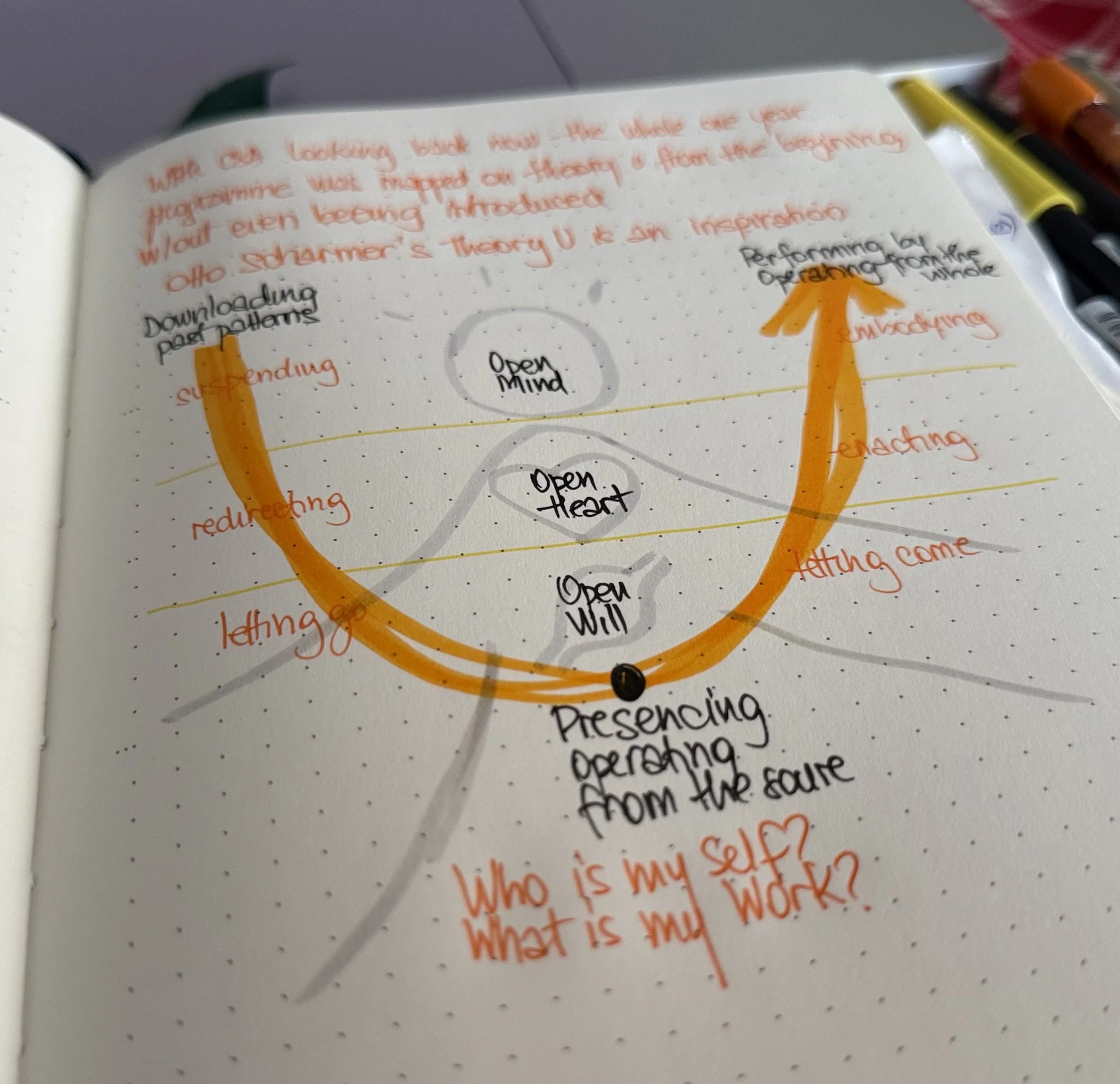
In 5D, the coaching work releases its grip on outcome. Otto Scharmer's Theory U (2009) is the most fully elaborated map of this territory: the movement from downloading and seeing, through sensing, to presencing, a state in which the practitioner sets aside both the patterns of the past and the projections of the future, in order to receive what is actually wanting to emerge. The earlier collaboration of Senge, Scharmer, Jaworski, and Flowers in Presence (2004) is a foundational text here.
Other lineages converge on the same ground. Arnold Beisser's paradoxical theory of change (1970) holds that change occurs not by trying to become different but by becoming more fully what one is. John Keats' notion of negative capability, the capacity to remain in uncertainty, mystery, and doubt without irritably reaching after fact and reason, was taken up by Wilfred Bion as a clinical posture. The Taoist wu wei, or non-coercive action, speaks to the same disposition. The 5D coach does not impose; they align. This might be the „pro-vocation”, mentioned by David in his final speech.
Clutterbuck's keynote distilled the same disposition in two phrases that the Coach Maturity Research Group has surfaced repeatedly: letting go, and doing less and being more. The discipline of 5D is the discipline of restraint of not adding when not adding is what the moment requires.
The conference handout's word adaptive sits slightly off for me at 5D. Ronald Heifetz's adaptive leadership (Leadership Without Easy Answers, 1994) is precisely about naming the underlying challenge and mobilising people to do the work, a register more aptly located in 4D. 5D is less adaptive in Heifetz's sense than receptive. The verb is not to act on but to align with.
The Non-Hierarchy Caveat - Strongly Restated
The conference handout flags it; this article underlines it. The five dimensions are not a ladder of human worth, nor a developmental staircase the coach is meant to ascend. They are a repertoire.
The competence is not to reach 5D but to read which register the work is calling for, and to move fluently between them. A client facing a contractual deadline needs 1D. A team caught in mutual misreading needs 2D. A leadership group whose decisions are rippling destructively through the organisation needs 3D. A leader whose identity is being remade by their role needs 4D. A board confronting a question that exceeds the available frames needs 5D.
Pushing any client to the wrong register, and most often, in our field, the error is pushing prematurely toward 4D and 5D, from my perspective. The 5D coach who cannot do 1D when 1D is needed is no more competent than the 1D coach who cannot reach 5D when only 5D will serve. However, I do appreciate and met colleagues who intentionally work and support clients only for a certain repertoire band, contracting what they could or could not do for their not necessarily based on the competence, but also based on the willingness.
A Practitioner's Frame
For day-to-day practice, the following diagnostic questions help us to locate where the work is calling.
Is there an urgent and bounded decision in front of the client? → 1D
Is the client locked inside a single frame, unable to see themselves or the context from another angle? → 2D
Are consequences cascading through a system in ways the client does not fully see? → 3D
Is the client's sense of who they are being remade by the work? → 4D
Is something larger than the available frames wanting to emerge? → 5D
The five questions can also be used as a personal audit. Which register is your default? Which do you avoid? Which were you not trained in? Supervision is the natural place to surface where one's register-fluency is uneven, and where one's preferences are silently shaping what the client can and cannot work on.
Conclusion: A Repertoire, Not a Ladder
The framework offered at Zagreb is generative precisely because it makes visible a movement many coaches make tacitly from a problem-solving stance toward a more emergent, field-aware one. Extending it downward to include 1D (linear) and 2D (reflective, mirror and window) recovers two registers that the original model bundles into 3D, and clarifies that systems thinking proper begins where consequences propagate, not where problems are fixed.
Read this way, the five dimensions become a repertoire with five postures the coach can adopt according to what the work demands. The skill is fluency: the capacity to enter each register competently, to leave each register when it has done its work, and to read which register the next moment requires. However, looking at it I realise how linear it is, and that in many cases, we are playing with postures based on how the clients’ need emerges. Also developing from three dimensions to five dimensions and especially the repertoire metaphor make me thinking if we missed two more dimensions. Like any model, it’s strength is in invitations and questions that emerge.
Three invitations for practitioners:
1. Notice your default. Most coaches have one register where they are most comfortable. That comfort is a strength, and it is also a constraint on what your clients can do with you.
2. Develop the registers you avoid. If you reach habitually for 4D or 5D, ask whether you can still do 1D cleanly when a client needs it. If you reach habitually for 1D, ask what you might be foreclosing when you turn every conversation into a solution.
3. Use supervision to surface register-mismatch. It is rarely the client who notices when the coach has chosen the wrong register. It is the supervisor, working in 4D who is most often positioned to question it.
A final observation. This five-register reading converges with a line of thinking David Clutterbuck has been developing for many years - the four-stage coach maturity arc from models-based (control), through process-based (contain) and philosophy-based (facilitate), to systemic eclectic (enable). Read together, our table-group extension and Clutterbuck's maturity model describe overlapping developmental terrain, not because either depends on the other, but because the field appears to be converging on a similar map from multiple directions. That convergence is itself worth noticing, and worth working with. I am glad that MOZAIC reciprocal mentoring programme provides the reflective space for EMCC members to reflect on the maturity (relational, professional and ethical) and practitioner journey.
The framework is most useful held lightly as a map that organises practice, not a hierarchy that ranks it.
A Bridge to South Korea, 2027
The 2027 EMCC Global Annual Conference will be held in South Korea. It is worth ending this article by naming a Korean concept that, more than any of the European or American theoretical anchors used above, captures what the five-dimensional reading is pointing at.
The word nunchi (눈치) literally "eye-measure" names the capacity to read the room before the room speaks. It is the speed and accuracy with which a person senses what is in the air: who is anxious, what is unspoken, what the situation requires, what one's own next move should be. In Korean cultural life it is not a soft skill or a peripheral virtue; it is a core competence, taught by example from childhood, considered essential to leadership, and lost only at one's peril.
What is striking, from the angle of this article, is that nunchi does not sit at any one register. It is precisely the meta-competence of register-reading itself. The practitioner with high nunchi is the one who knows, in a given moment, whether the conversation calls for solving (1D), perspective-taking (2D), tracking consequences across the system (3D), accompanying an identity in transition (4D), or letting something emerge that exceeds the available frames (5D).
Similar competences are named in neighbouring traditions. The Buddhist concept of upaya (Sanskrit: upāya-kauśalya, "skill in means") holds that the teacher's method must match the student's capacity - anything else is failed practice, however technically correct. The Sanskrit viveka names the discernment that distinguishes the essential from the inessential. The Chinese shi (势) names the inherent propensity of a situation - what is already wanting to happen, which the wise actor aligns with rather than overrides. Wu wei, already named in this article at 5D, is the practice of acting only when one's action serves what is already in motion.
Read against these traditions, the European map of five registers begins to look like a structured articulation of a competence other cultures have named and cultivated for many generations: the capacity to perceive what is needed, and to act in a manner congruent with it. There is a useful complementarity here. Western coaching has been strong on theorising the registers. East Asian and South Asian traditions have been strong on cultivating the reading.
The move from Zagreb to South Korea, from naming the registers to refining the discernment that selects among them, is a natural next step for the field. Practitioners arriving at the 2027 conference will find themselves on ground where the discernment competence is a public, taught virtue. There is much to learn from being there. And make the Conference as a meeting point that brings us together.
References
Argyris, C., & Schön, D. A. (1974). Theory in Practice: Increasing Professional Effectiveness. Jossey-Bass.
Bachkirova, T. (2011). Developmental Coaching: Working with the Self. Open University Press.
Beisser, A. (1970). The paradoxical theory of change. In J. Fagan & I. L. Shepherd (Eds.), Gestalt Therapy Now (pp. 77–80). Science and Behavior Books.
Bion, W. R. (1970). Attention and Interpretation. Tavistock.
Clutterbuck, D. (2020). Coaching the Team at Work (2nd ed.). Nicholas Brealey.
Clutterbuck, D. (2026, May). What is the profession becoming and how are we shaping it? Keynote address, EMCC Global Annual Conference, Zagreb, 10–13 May 2026.
Hawkins, P. (2014). Leadership Team Coaching: Developing Collective Transformational Leadership (2nd ed.). Kogan Page.
Hawkins, P., & Smith, N. (2013). Coaching, Mentoring and Organizational Consultancy: Supervision, Skills and Development (2nd ed.). Open University Press.
Heifetz, R. A. (1994). Leadership Without Easy Answers. Harvard University Press.
Hong, E. (2019). The Power of Nunchi: The Korean Secret to Happiness and Success. Penguin.
Jullien, F. (1995). The Propensity of Things: Toward a History of Efficacy in China. Zone Books.
Kegan, R. (1994). In Over Our Heads: The Mental Demands of Modern Life. Harvard University Press.
Luft, J., & Ingham, H. (1955). The Johari Window: A graphic model of interpersonal awareness. Proceedings of the Western Training Laboratory in Group Development. UCLA.
Meadows, D. H. (2008). Thinking in Systems: A Primer. Chelsea Green.
Mezirow, J. (1991). Transformative Dimensions of Adult Learning. Jossey-Bass.
Scharmer, C. O. (2009). Theory U: Leading from the Future as It Emerges. Berrett-Koehler.
Schön, D. A. (1983). The Reflective Practitioner: How Professionals Think in Action. Basic Books.
Senge, P. M. (1990). The Fifth Discipline: The Art and Practice of the Learning Organization. Doubleday.
Senge, P., Scharmer, C. O., Jaworski, J., & Flowers, B. S. (2004). Presence: Human Purpose and the Field of the Future. SoL.
Whitmore, J. (1992). Coaching for Performance. Nicholas Brealey.