Mastery of the 2026 Complexity Landscape
Article written by Vlad Duțescu - EMCC România’s President
In 2026, the global strategic environment has transcended simple volatility. We now operate in a state of SHIVA—a reality characterized by polarized, shattered, and often "horrifying" systemic shifts that render 20th-century risk management obsolete. This article presents a unified field theory for leadership, providing a cognitive architecture to move from existential paralysis to operational agency.
In an era where volatility has become the baseline rather than the exception, practitioners face a critical challenge: the frameworks we use to understand complexity are not the same as those that help us act within it.
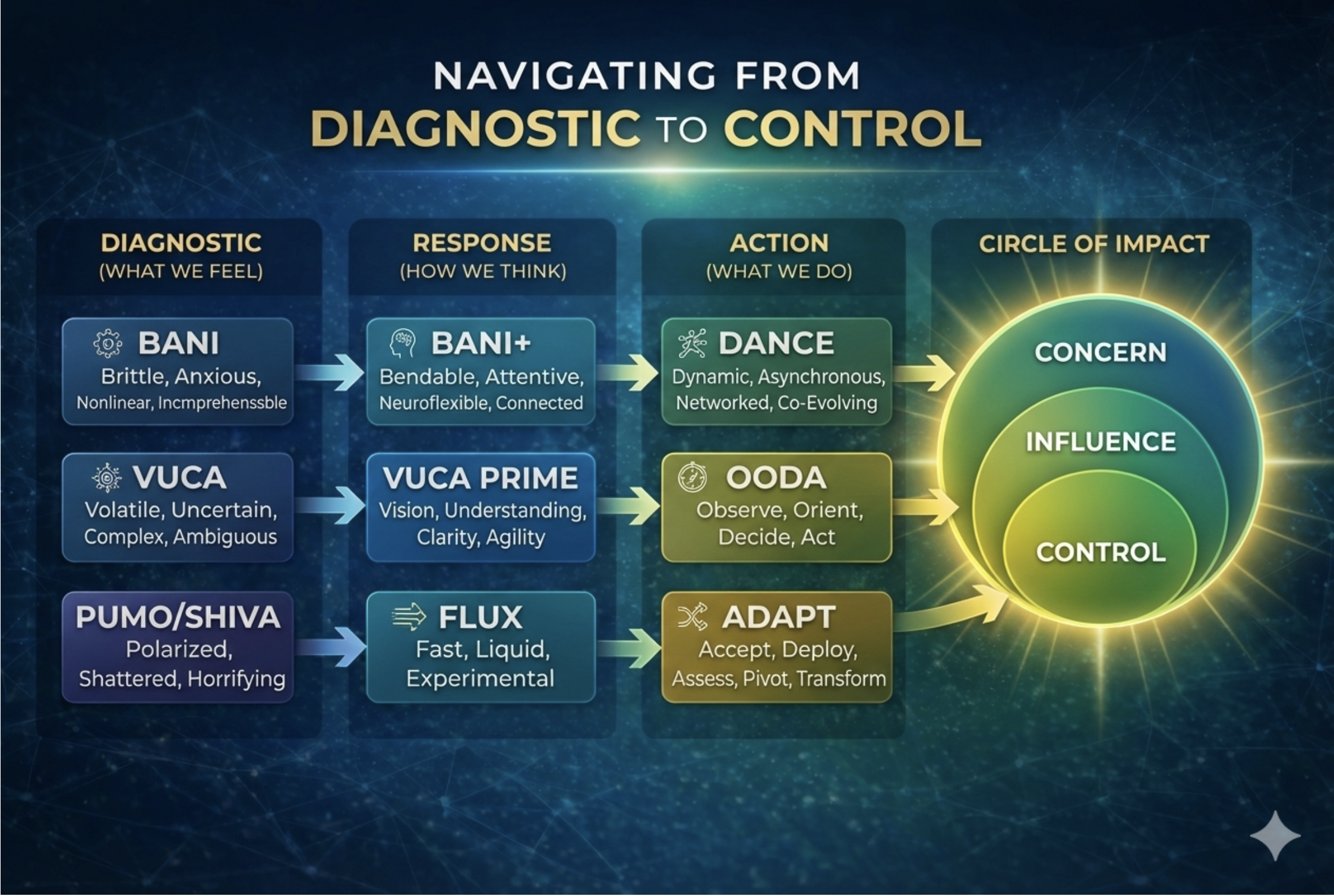
Navigating from Diagnostic to Control
This visual synthesis captures a core insight from our reflective guide "Navigating Complexity: Framework Models for Leaders, Coaches, Mentors & Team Coaches" that effective practice requires movement through three distinct phases:
Diagnostic (What We Feel): Frameworks like BANI, VUCA, and PUMO/SHIVA help us name the nature of our environment - brittle, volatile, polarized - giving language to experiences that might otherwise overwhelm.
Response (How We Think): The corresponding positive frameworks - BANI+, VUCA Prime, FLUX - shift our orientation from describing problems to developing internal capacities: bendability, vision, experimental agility.
Action (What We Do): Models like DANCE, OODA, and ADAPT provide concrete rhythms for decision-making and adaptation, translating mindset into movement.
The convergence point matters: Covey's Circle of Impact reminds us that regardless of which pathway we travel, our ultimate leverage lies in distinguishing what we can control from what we can merely influence or must simply acknowledge.
The image represents selected pathways from a broader ecosystem of 16 frameworks that we will continue to examine below, which includes detailed applications and reflective prompts for individual coaching, mentoring relationships, and team coaching contexts.
Dedicated to the EMCC Global Community
"In times of turbulence, the greatest danger is to act with yesterday's logic." Peter Drucker
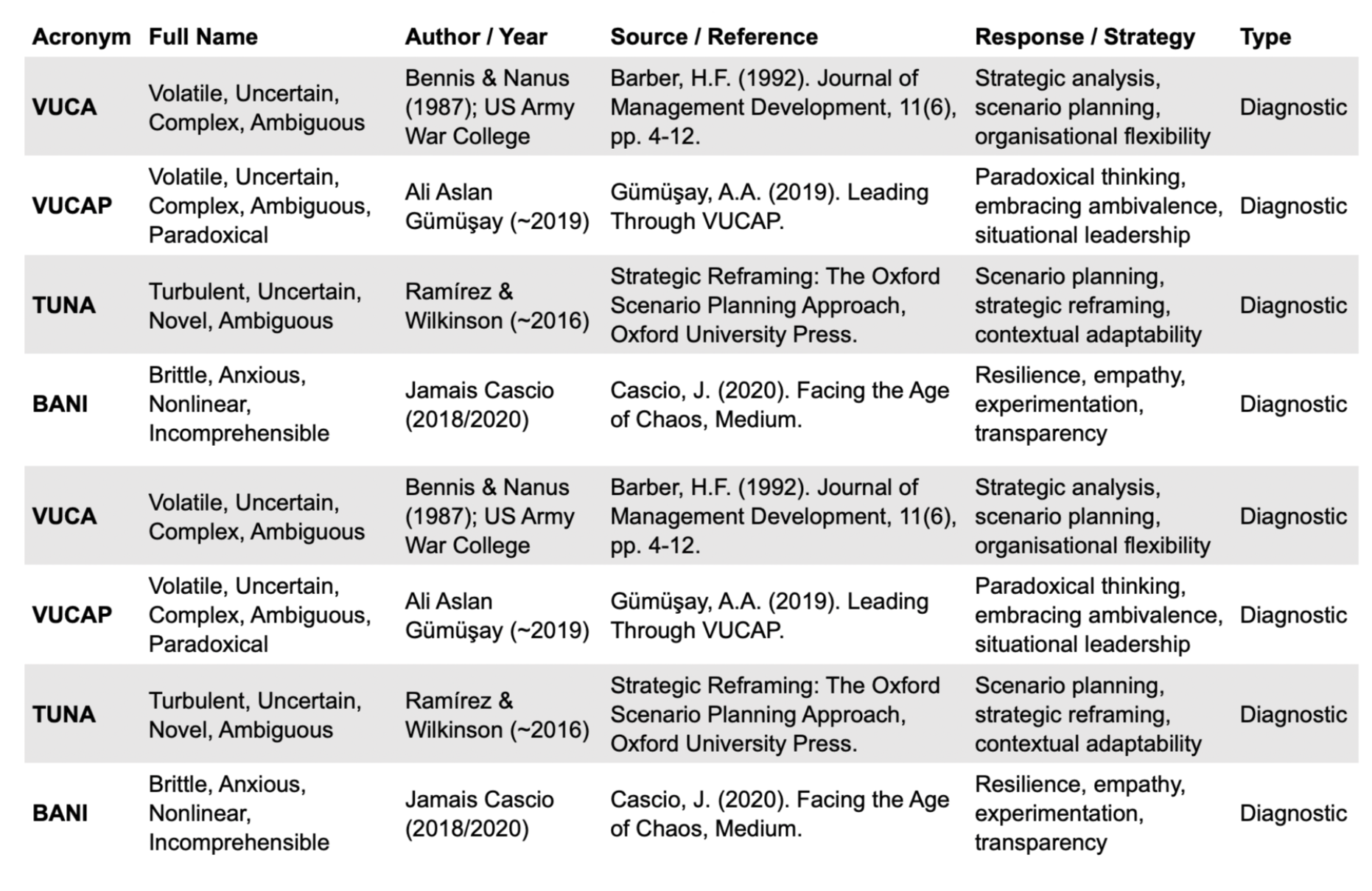
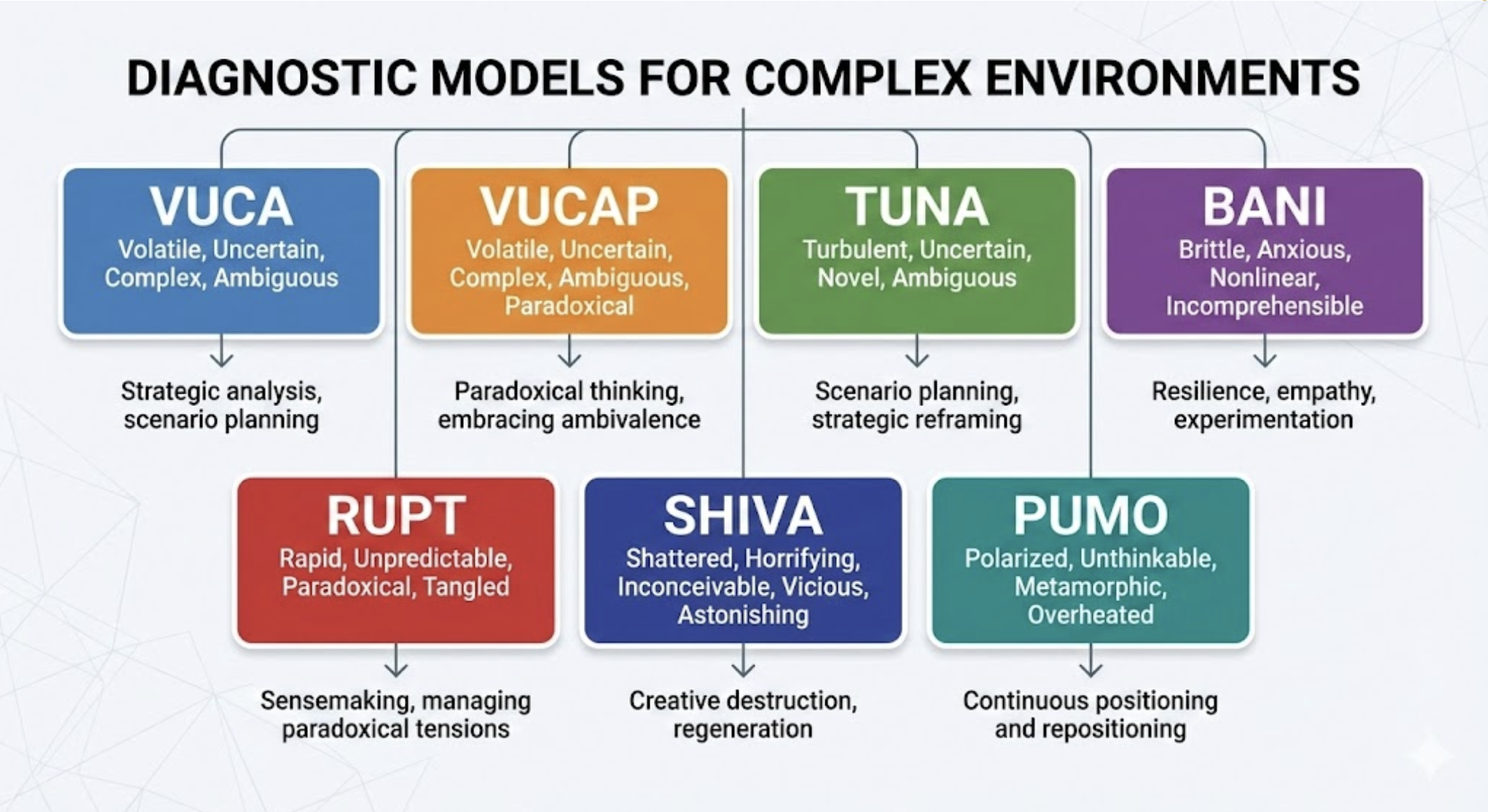
Part1: Diagnostic Models - Understanding the Challenge
These frameworks help us name and understand the nature of today's complex, volatile environments.
Part 2: Positive Response & Action-Oriented Models — Navigating the Challenge
These frameworks provide response strategies, mindsets, and action orientations for thriving amid complexity.


The Relationship Between Diagnostic and Response Models
Understanding complexity is necessary but not sufficient. Leaders, coaches, mentors and team coaches must move from diagnosis to action.
Understanding Our Role in Complex Systems
The proliferation of these frameworks reflects a profound truth: we are living through an unprecedented acceleration of complexity. As practitioners working with individuals and teams, we must recognise that our clients, coachees, and mentees are navigating these turbulent waters daily.
The Coaching & Mentoring Perspective
What do these frameworks mean for our practice?
For Coaches: These models provide a shared language for exploring how clients experience their professional and personal environments. When a coachee says "everything feels chaotic," we can help them distinguish between volatility, uncertainty, complexity, and ambiguity, each requiring different responses. The diagnostic models help clients name their experience; the action models help them navigate it.
For Mentors: As experienced guides, mentors can share how they have navigated similar complexity in their own careers. The DANCE framework particularly resonates with mentoring, accepting that we cannot control the system, but we can learn to move with it, to co-evolve with changing circumstances.
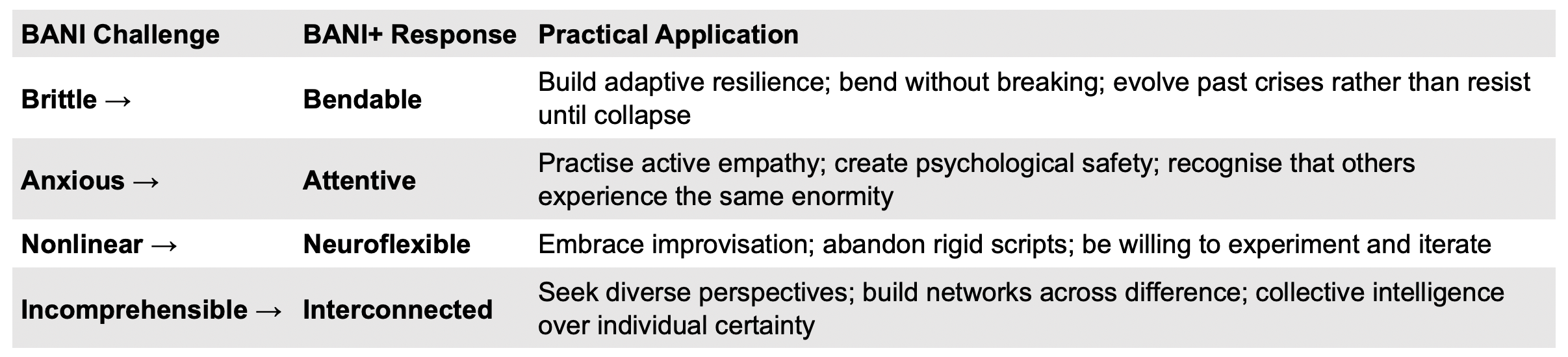
For Team Coaches: Teams face compounded complexity as individual uncertainties interact and amplify. The OODA loop offers teams a shared decision-making rhythm, while BANI+ reminds us that team resilience comes from being Bendable (adaptive structures), Attentive (empathetic to members' anxiety), Neuroflexible (willing to improvise), and Interconnected (drawing on diverse perspectives).
The Circle of Influence Perspective (Covey)
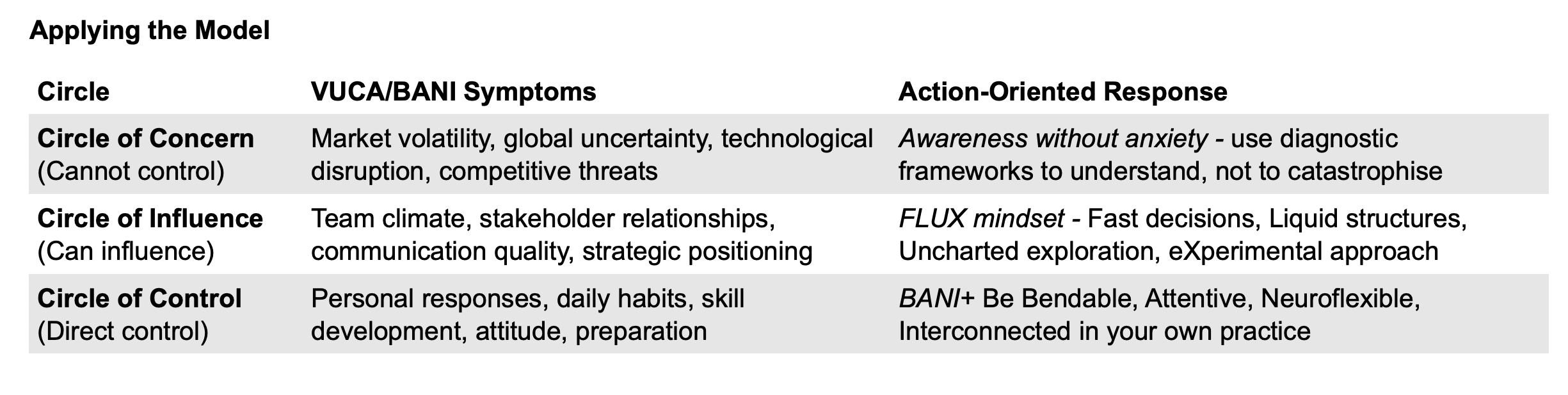
Stephen Covey's Circle of Influence model provides a powerful lens for applying these complexity frameworks.
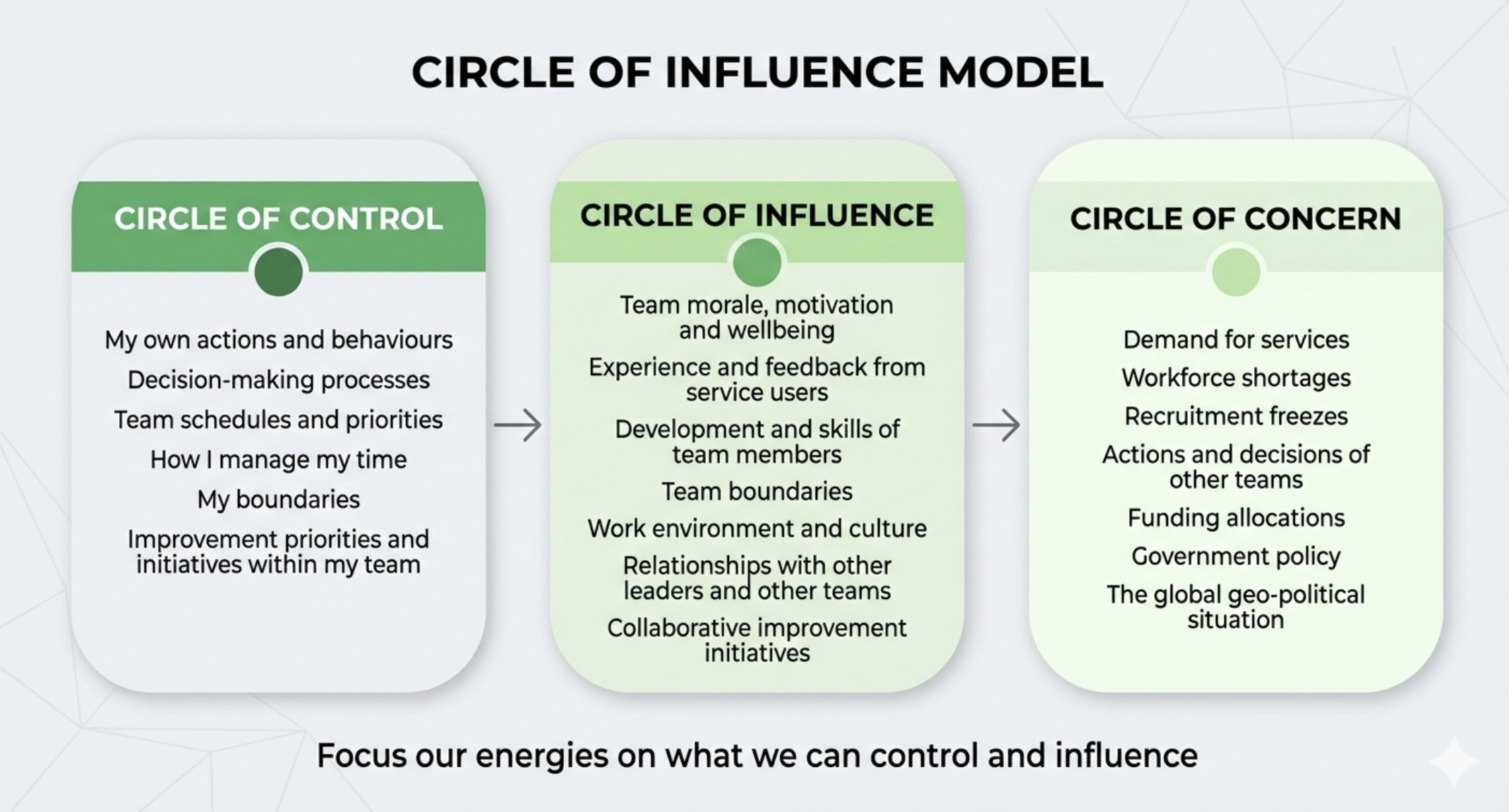
Circle of Concern vs. Circle of Influence
In VUCA/BANI environments, it is easy to become overwhelmed by the Circle of Concern - all the things we worry about but cannot directly control: global markets, geopolitical tensions, technological disruption, pandemic risks, climate change, and organisational restructuring.
The complexity frameworks, particularly the action-oriented ones, invite us to refocus on the Circle of Influence - the areas where our actions can make a difference.
For Coaches & Mentors
When working with clients who feel overwhelmed by complexity:
Help them map their circles: What is in their Circle of Concern that they're treating as if it were in their Circle of Control?
Identify influence opportunities: Where can they actually make a difference? What relationships, decisions, or actions fall within their influence?
Build "response-ability": The action-oriented frameworks (VUCA Prime, BANI+, FLUX) are not about controlling the external environment. They are about developing the internal capacity to respond effectively.
Develop systemic awareness: Help clients see that even within their Circle of Influence, they are part of larger systems. Their actions create ripples; their responses shape others' responses.
For Team Coaches
Teams often struggle with collective overwhelm. The Circle of Influence model, combined with these frameworks, offers a structured approach:
Collective mapping: What does the team collectively worry about? What can they collectively influence?
Role clarification: Different team members may have influence over different parts of the system. Map this explicitly.
Shared response patterns: Use OODA or ADAPT as a team rhythm for collective decision-making in uncertainty.
Psychological safety: Teams cannot be Neuroflexible (BANI+) without the safety to experiment and fail.
Deep Dive: Key Action-Oriented Models
BANI+ (Cascio, Johansen & Williams, 2025) - The official response to BANI, developed by its creator Jamais Cascio together with Bob Johansen and Angela Williams:
FLUX (Fisk, 2025) - An emergent framework for the AI era and accelerated digital transformation:
Fast: Change is continuous and compounding. Real-time adaptation is a core competency.
Liquid: Traditional boundaries dissolve. Success comes from fluid ecosystems, not rigid structures.
Uncharted: The AI era rewrites the playbook. Past data may not predict the future.
eXperimental: Progress comes from experimenting, learning, and adapting at speed, not from finding the perfect answer.
DANCE (PMI Research) - A framework acknowledging the nature of complex project and organisational environments:
Dynamic: Constantly changing, driven by turbulent factors and shifting stakeholder needs
Asynchronous: Events don't follow predictable sequences; cause and effect are decoupled
Networked: Interconnected dependencies; actions ripple through systems in unexpected ways
Co-evolving: System and environment shape each other continuously
Emergent: Solutions and problems emerge from interactions, not from top-down design
The DANCE metaphor is powerful: you cannot control your dance partner, but you can learn to move together.
OODA Loop (Col. John Boyd, 1970s) - Originally developed for military aviation, now widely applied in business:
Observe: Gather information from the environment
Orient: Contextualise observations against experience, culture, and mental models
Decide: Choose a course of action
Act: Execute the decision
The key insight: whoever can cycle through the loop faster gains advantage. But speed without orientation leads to recklessness. The Orient phase, understanding context, recognising biases, building mental models, is the most critical and often undervalued.
Implications for Professional Practice
For Individual Coaching
Assessment. Help clients recognise which type of challenge they face (VUCA, BANI, etc.).
Reframing. Move from "the world is chaotic" to "I can develop specific responses".
Capacity building. Focus on building the internal qualities that enable navigation (agility, resilience, clarity).
Action orientation. Use frameworks like OODA and ADAPT to structure experimental action.
For Mentoring Relationships
Shared experience. Mentors can share how they have navigated similar complexity.
Pattern recognition. Help mentees see patterns across different types of uncertainty.
Wisdom transfer. The "Orient" phase of OODA draws on experience; mentors help build this repertoire.
Co-navigation. Modern mentoring is mutual; both parties learn in DANCE mode.
For Team Coaching
Collective explore & discovery. Help teams name what they're experiencing.
Shared language. These frameworks provide vocabulary for team conversations.
Distributed response. Different team members may excel at different aspects (some are naturally Bendable, others Attentive).
Team rhythm. Establish collective decision-making cycles (weekly OODA reviews, monthly ADAPT cycles).
Psychological safety. Essential for Neuroflexibility; teams cannot experiment without safety to fail, making failure as an learning and developing opportunity.
Questions for Reflection
For Leaders
Which diagnostic model best describes your current environment? Has it changed recently?
Which action-oriented model resonates most with your leadership style? And what leadership style is needed for your team(s) and organisation now?
Where are you spending energy in your Circle of Concern that could be redirected to your Circle of Influence?
For Coaches
How would these frameworks enrich your coaching conversations?
When clients feel overwhelmed by complexity, which model might help them find clarity?
How do you develop your own BANI+ qualities to model for clients?
For Mentors
What have you learned about navigating complexity that you can share with mentees?
How has your approach to uncertainty evolved over your career?
Which DANCE moves have served you well?
For Team Coaches
How does the team collectively respond to complexity? What patterns do you observe?
Which team members bring natural strengths in different response modes?
What would help this team develop greater collective Neuroflexibility?
References
Primary Sources - Diagnostic Models
Barber, H.F. (1992). 'Developing Strategic Leadership: The US Army War College Experience', Journal of Management Development, 11(6), pp. 4-12.
Bennis, W. & Nanus, B. (1987). Leaders: Strategies for Taking Charge. Harper & Row.
Cascio, J. (2020). 'Facing the Age of Chaos', Medium.
Gümüşay, A.A. (2019). 'Leading Through VUCAP'. Academic research on paradoxical leadership.
Lichtenthaler, U. (2025). 'The PUMO world: Understanding the new business environment'. ulrichlichtenthaler.com.
Ramírez, R. & Wilkinson, A. (2016). Strategic Reframing: The Oxford Scenario Planning Approach. Oxford University Press.
Center for Creative Leadership. 'Navigating Disruption With RUPT: An Alternative to VUCA'. CCL Articles.
Primary Sources - Action-Oriented Models
Boyd, J. (Various). OODA Loop writings and presentations. US Air Force.
Cascio, J., Johansen, B. & Williams, A. (2025). Navigating the Age of Chaos: A Sense-Making Guide to a BANI World that Doesn't Make Sense. Berrett-Koehler.
Fisk, P. (2025). 'FLUX Strategy: How to Develop a Business Strategy in a World of Relentless Change'. peterfisk.com.
Johansen, B. (2007). Get There Early: Sensing the Future to Compete in the Present. Berrett-Koehler.
Richards, C. (2004). Certain to Win: The Strategy of John Boyd Applied to Business. Xlibris.
Duggal, Jack S. (2010). 'Managing the DANCE'. Project Management Institute.
Walker, N. (~2024). 'Above and Beyond VUCA: The Rise of BANI, RUPT, TUNA'. neilwalker.net.
Supporting Literature
Covey, S.R. (1989). The 7 Habits of Highly Effective People. Free Press.
Edmondson, A. (2019). The Fearless Organization: Creating Psychological Safety in the Workplace. Wiley.
Heifetz, R. & Linsky, M. (2002). Leadership on the Line. Harvard Business School Press.
Snowden, D. & Boone, M. (2007). 'A Leader's Framework for Decision Making', Harvard Business Review.
Uhl-Bien, M. & Arena, M. (2017). 'Complexity leadership: Enabling people and organizations for adaptability', Organizational Dynamics, 46(1), pp. 9-20.
About This Article
This article was prepared for the EMCC Community as a resource for coaches, mentors, team coaches, and supervisors working in complex environments.
The frameworks presented here are tools for understanding and action, not rigid prescriptions. As practitioners, we hold these models lightly, using them to illuminate rather than constrain.
"The map is not the territory." Alfred Korzybski
Our role is to help our clients, coachees, mentees, and teams develop their own capacity to navigate complexity, to find their own rhythm in the DANCE. In order to do these successfully, we first need to make sure we are capable to do it for ourselves.
“EMCC Global exists to create human impact that improves lives, organisations, and society.”